

Sigh. An obligatory note on AI and writing.
Student Resources, Chapter 1
I can’t stand talking about AI, at least when it comes to the topic of (creative and academic) writing. (Just so you know, I’m not against people using AI to generate workplace emails or stock reports or complete mundane tasks that don’t require or augment critical thinking or creative skills.) And yet, in the last few years, this is all anyone wants to talk about — or, more accurately — freak out about. This is especially true in writing-heavy departments like English or Comparative Literature or any discipline that asks you to churn out a final paper instead of a final exam — so basically, we’re talking about the entirety of the humanities.
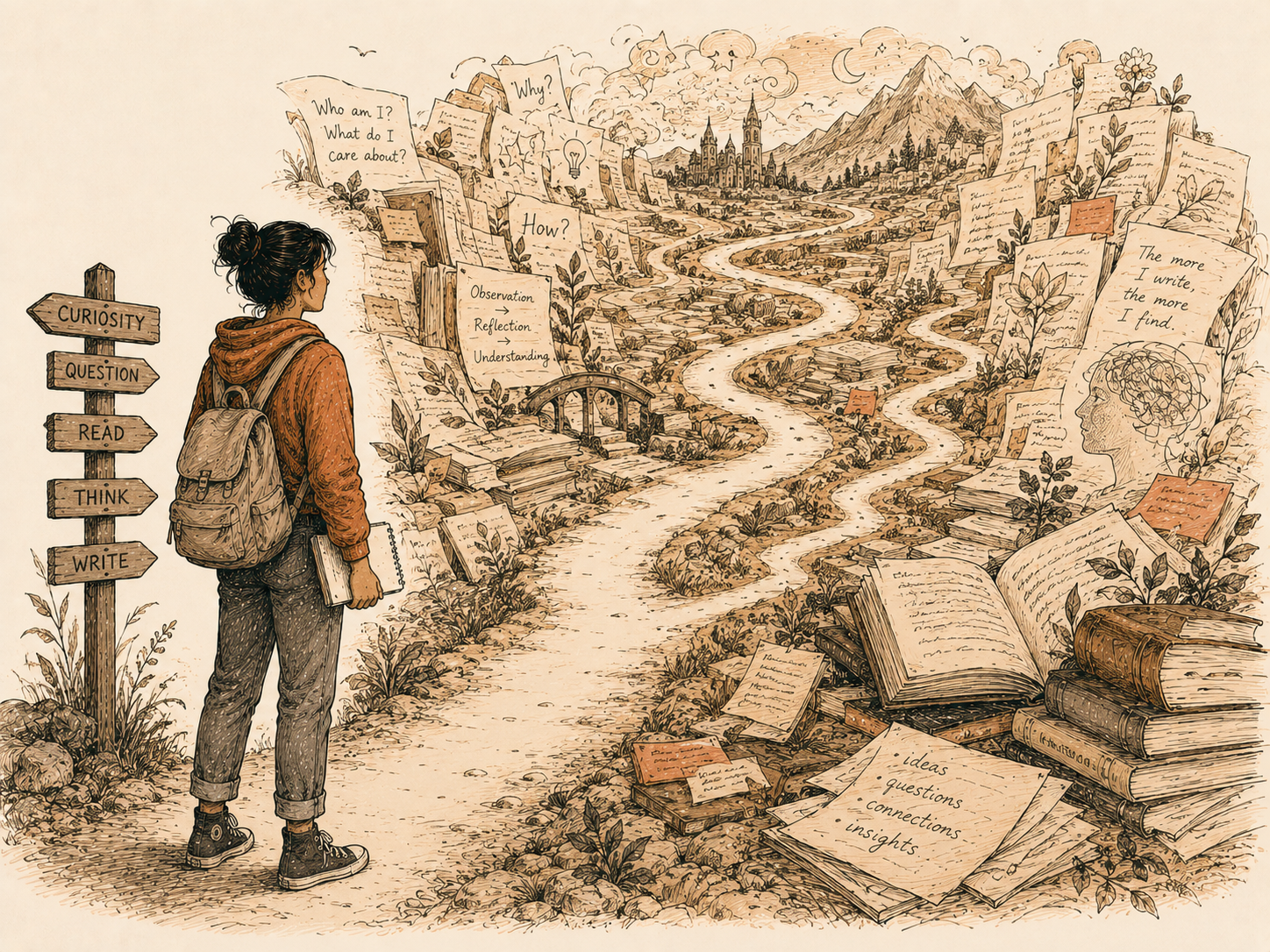
In the early 21st century, this is not new news. The humanities in general, even before AI came onto the scene, had been facing that scary cliff of near extinction. That cliff has been called fiscal insolvency or cultural irrelevancy or political strong-arming, especially as our economy grows and feeds off STEM-based majors.1 These days we can just call that cliff “AI” because as you savvy students all now know, any major LLM (large language model, like the ever-pervasive and popular ChatGPT) can churn out an essay in no time at all and probably still garner that essay a “B,” as long as you know how to give that LLM specific commands that fulfill an instructor’s expectations. That LLM can even give you an “A” as long as you know enough about the subject matter to check and edit the output the LLM is generating, thereby augmenting the essay you’ve been given.
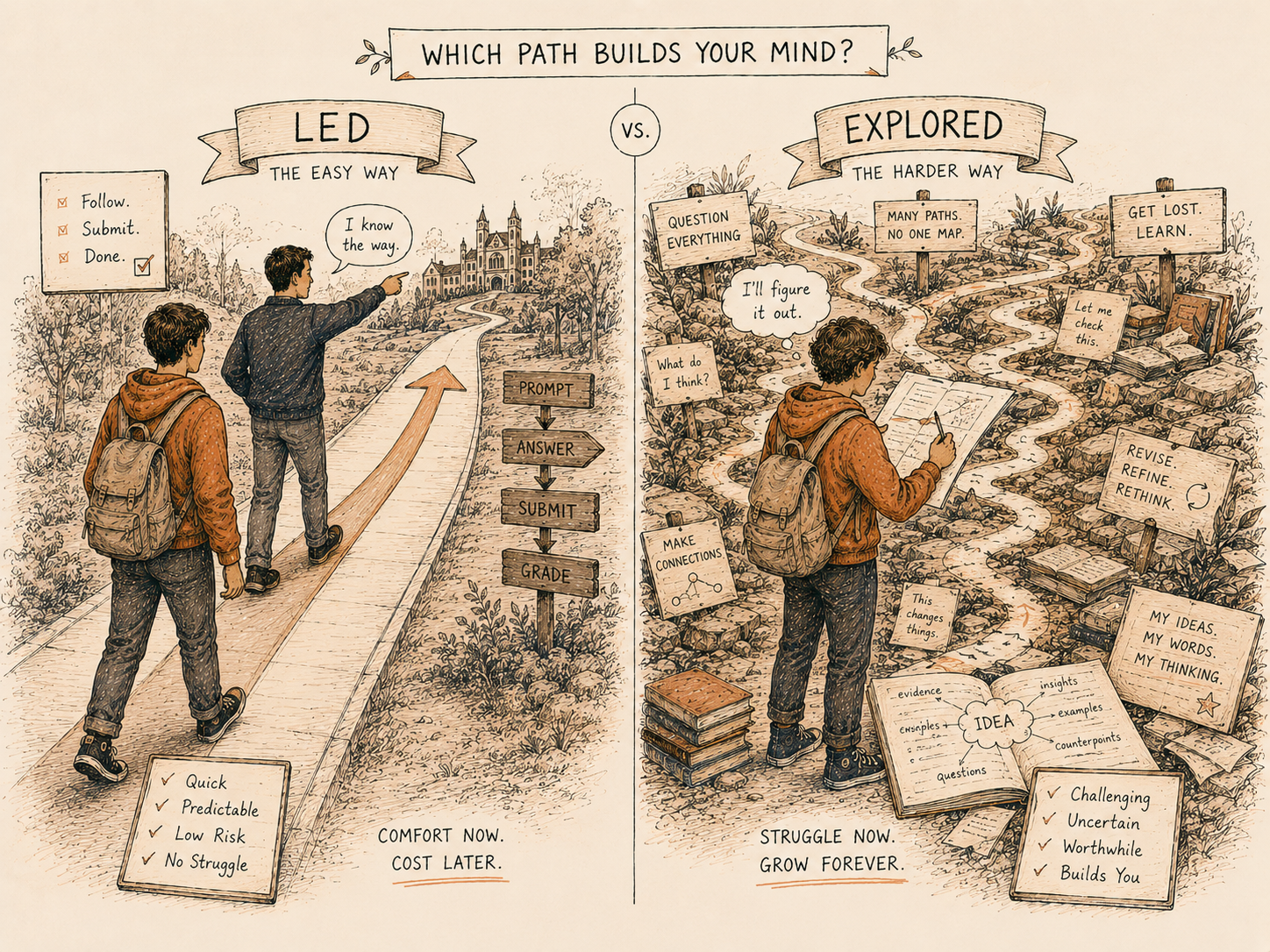
Think of it this way. You’re a kid who has never been left alone to navigate the streets in your town or city. Your parents, your guardian, your caregiver — whoever — some adult —has always been there to lead you, protect you, help you find your way from point A to point B. Maybe you were driven around. Maybe you were walked or biked around. At the age of 5, this made sense. But now you’re no longer 5; you’re now 17, on the verge of going into adulthood. And you still don’t know what those streets around you are. You’re still being driven around by some adult who - for fear of the world and its chaos - won’t let you go off alone. Are you going to know those streets the same as the kid who was left to roam the neighborhood at will, at some point in childhood? Of course not. And there may be excellent reasons that those adults didn’t let you explore your streets. But the “cognitive cost” to you is now real, because you’re now 17-going-on-18, going on to the big, wide world beyond, and you just don’t know how to navigate around town by yourself.
So then, my exhaustion at hearing the words “AI” and “writing” in the same sentence. Why?
First, there have always been students looking for shortcuts in their education. Students have always faced the temptation of getting an easy “A” or “B” or what have you, by cheating. And if you are in that spot right now, so cornered in your life that you feel you have no other “out” than to call on an AI god to help you get through a literature class, then okay. I get you. I see you. I hope I can still convince you not to go that way. At least not right now, at the beginning stages of your academic career, when your critical faculties are still developing.
Because, second, the deleterious effects of AI are now increasingly scary and real, as the now-landmark 2025 study from MIT Media Lab Study has established. I’m just going to skip to the general conclusions the authors of that study came to: “The LLM undeniably reduced the friction involved in answering participants' questions compared to the Search Engine. However, this convenience came at a cognitive cost, diminishing users' inclination to critically evaluate the LLM's output or 'opinions' (probabilistic answers based on the training datasets).” I just want to highlight the phrase “cognitive cost.” No one wants to say this out loud. No scientist is going to use crude, basic language to get a major point across. But I’ll say it. This study - whether it wants to or not - is leading me to the conclusion that AI — used by a beginning writer who hasn’t developed the ability to “critically evaluate” material (as opposed to the professional who already has expert knowledge and can use AI in a critical and intelligent way — a major distinction!) — makes that beginning writer more stupid.
I know that’s a bold claim. And I want to be clear: If you’re a beginning writer, this doesn’t mean that you are somehow genetically, biologically “stupid.” Everyone can write in English as long as they have some reasonable instruction in the core logic and rules of the language and they’re committed to learning more as they go along — this is a truism I actually believe in. What I mean by the phrase “more stupid” is simple: if you use AI and you haven’t developed the musculature, the neural pathways, in your brain to do the kind of writing that universities and professional work demand — a kind of writing I will call “writing as thinking” — then you’re definitely not going to develop those pathways in the future, if you depend on AI to do your thinking/writing for you from the beginning.
Regarding ethical considerations, participants who were in the Brain-only group reported higher satisfaction and demonstrated higher brain connectivity, compared to other groups. Essays written with the help of LLM carried a lesser significance or value to the participants (impaired ownership, Figure 8), as they spent less time on writing (Figure 33), and mostly failed to provide a quote from their essays (Session 1, Figure 6, Figure 7).
What are these people saying? It seems to me, these two things: 1) students who didn’t use an LLM to write their essay felt more “satisfaction” and more “brain connectivity” after writing their essay — in other words, they felt their own value as thinking, living beings more; 2) those who used LLMs didn’t accrue these positive benefits to their own well-being because they just didn’t put in the time to do the work themselves.
To me, this all comes down to one thing: How much do you want to prioritize your own intellectual and emotional well-being? Because those two things are intimately linked, when it comes to academic writing and the life of a university student.
I know it might not seem that way. Too often, our academic system — maybe from high school on — turns reading and writing into a chore, only with super-high stakes. It’s like, you have to wash the dishes and carry out the trash (or its equivalent, a 5-paragraph essay - GROAN), and if you don’t do it the way your teacher expressly told you to do it, you might not get into a good college/university, and you might not have a career one day that will give you the life you’ve always dreamed of, and so you might not even be able to afford that family, house, car, dog, etc…! And so the catastrophizing goes on.
Can we just push the “reset” button?
I imagine this is maybe what your brain is like, if it’s on AI from the beginning of your academic career. You’ve never allowed yourself to fully explore the wilds of your mind. Your rich, beautiful, complex, super-weird mind. Your fabulous mind that makes you YOU. You’ve always had some machine scripting and directing your path to a voice and a way of thinking that — sure, sounds fine and acceptable to the abstract, general masses out there — but doesn’t ever feel like the YOU that you know to be in there, down deep, unseen, unmined, undiscovered. And if you leave that part of you that’s wild and free down far below in the deep crevices within you, will you ever discover yourself? Will you ever become discoverable?
Which brings me to my third reason. The authors of that same MIT study also concluded this:
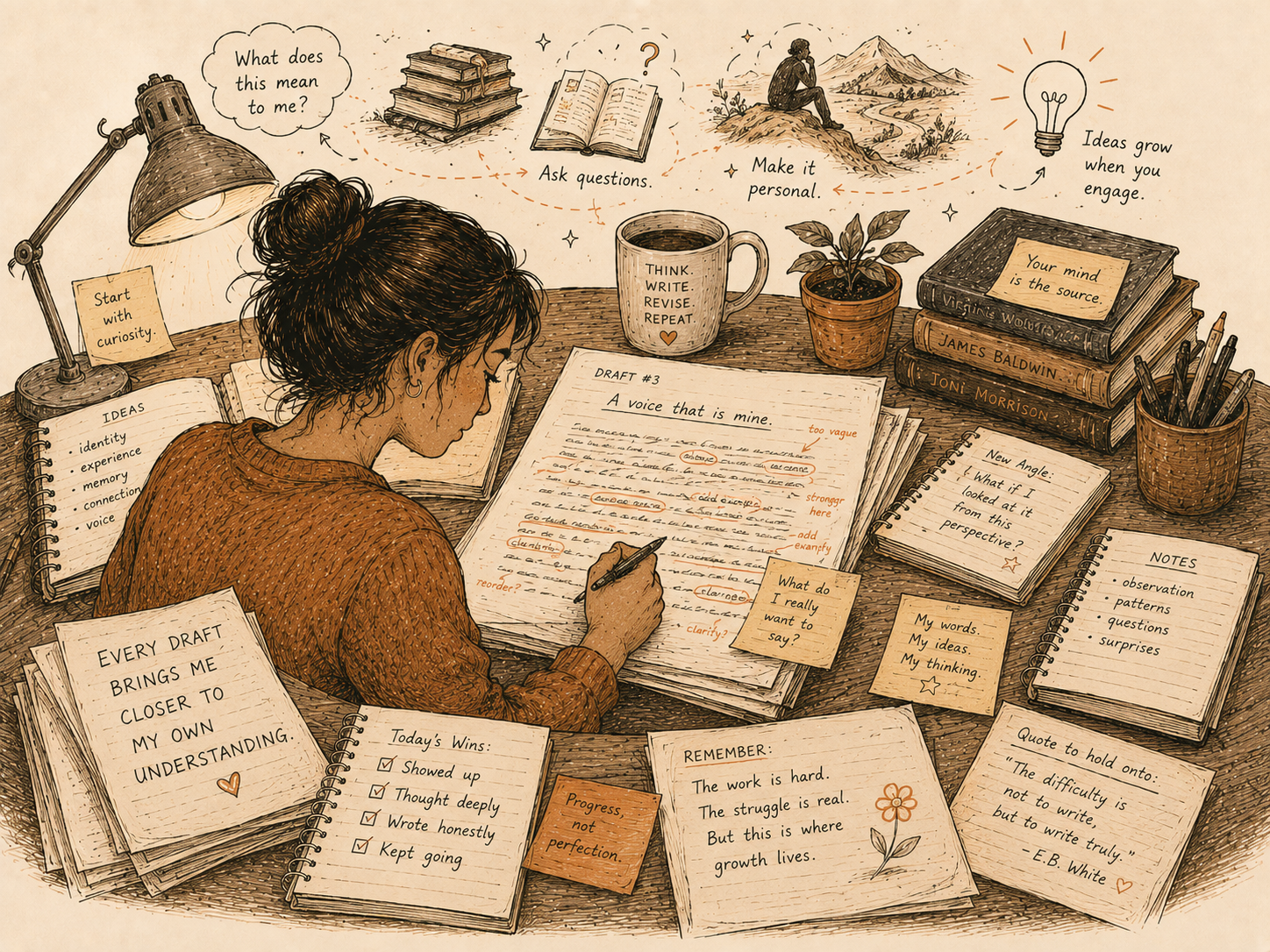
If you’re that student who thinks writing (specifically, academic writing) is a) hard b) boring c) irrelevant to your life goals or d) all of the above, I want to challenge you. Academic writing doesn’t have to erase the you-ness of you. The best of academic writing — of all writing — unleashes a part of you that’s undeniably you. If you’re an experienced writer, who has already established your own writing process and a mindset focused on revision rather than perfection, then — yes, it’s entirely possible to use AI AND still maintain the intellectual and stylistic tics that define you as a great writer and thinker. But if you’re reading this article right now, I’m guessing you’re not there yet.
So how do we — you — all of us — get to that point where you can see yourself in that 1st-year reading/comp essay on some book you could care less about? Read on, dear reader, read on.
-
This may be changing. It's now the beginning of summer 2026 in the Bay Area, where I am writing, and in this half-year alone, Meta, LinkedIn, Intuit, and more tech companies have laid off thousands of employees, mostly because AI is replacing these people. So maybe constructing technology that can make your own job and thousands of others in tech obsolete wasn't the best move. And maybe that means the humanities might be making a comeback in terms of college majors, because what's the point in becoming a Computer Science major when there might not be a job at the end of it all? Or maybe — and more likely — it changes the way college students view the validity of a college degree versus a vocational career like becoming a nurse or an electrician, where AI-replacement is less likely. Or maybe we approach the singularity and just become inconsequential human leftovers in a world remade and run by AI. At which point, we all have bigger concerns than whether or not you should use AI to generate an essay for your university-mandated 1st-year writing course. ↩