

Be Messy
Student Resources, Chapter 2
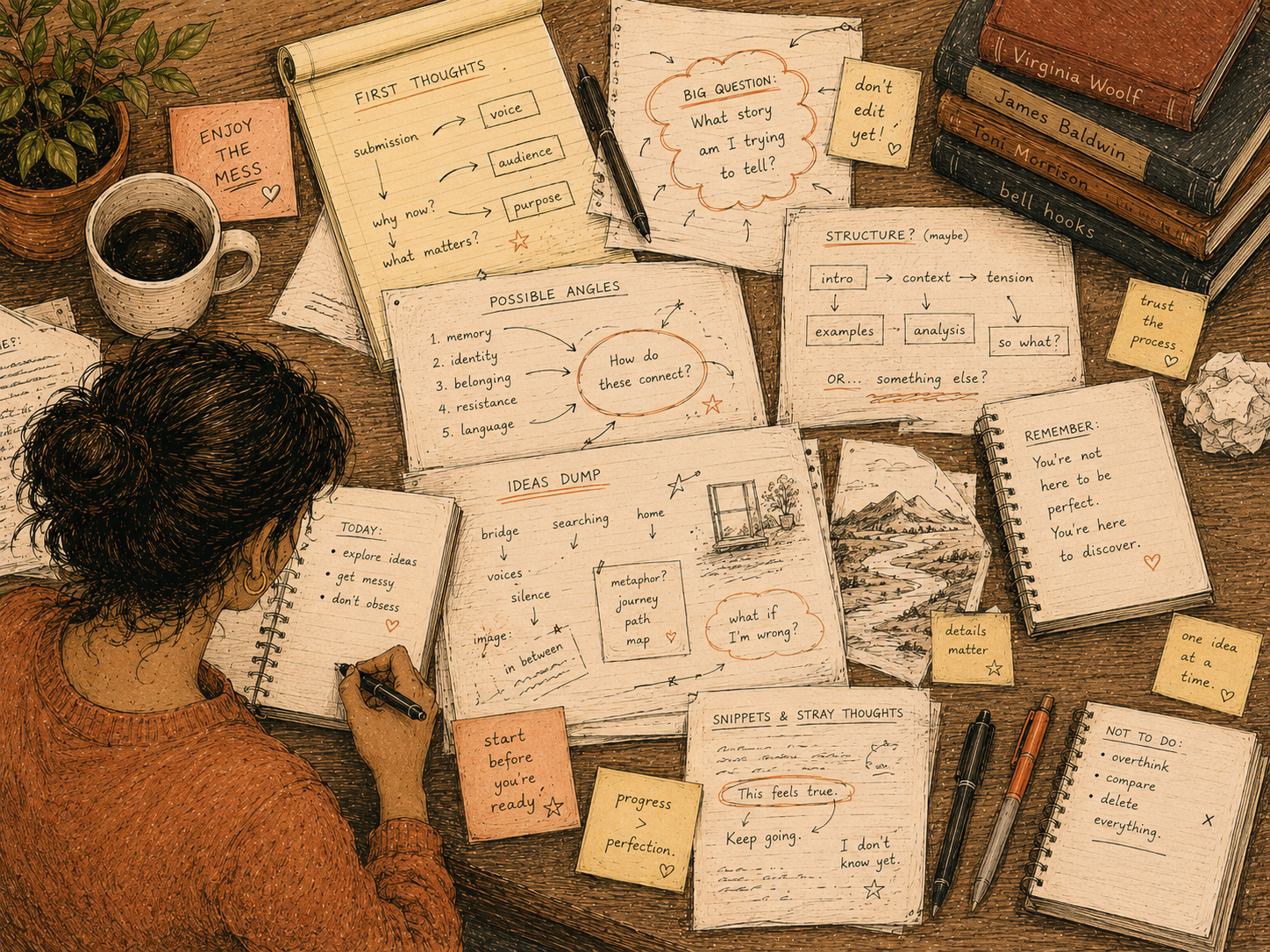
Who are you when you don’t (want to) write?
Are you the one who can’t proceed because you can’t think of the “perfect” word?
Are you the one who has better, more important things to do?
Are you the one who can’t stand feeling isolated from the world outside?
Are you the one who thinks “I’m just not a writer” or “I’m just not good with words”?
Or are you all four of these personalities? At the same time? On any given day?
Depending on what you’re telling yourself about writing, there are various strategies you can tap to counter these mental tendencies.
BUT nothing will work unless you embrace this guiding principle:
ENJOY THE MESS.
Any creative act starts with your willingness to step into a big pile of crap, jump around, and roll around in it. Writing your typical academic essay is no different - you’re still creating meaning. It’s just that you’re dealing with a written form that, over the years, has had so many, sometimes conflicting, expectations placed on it.
You can’t think about all of that at the beginning of the process. Shut out all those voices that stream into your head. That moment where you just have to start? It’s the most important part of the writing process.
It’s also the part that beginning writers often skip because they’re thinking they don’t need to do prep work, brainstorming, or any of that “pre” writing stuff. They think they’re saving time by skipping this part. They think that they want that finished product done in 1 day rather than over a series of days.
But really - and you have to believe me here - if that’s you, you’re not saving time. If you intend to write an essay in a few hours or all in a day, you’re also setting yourself up for 1) an uneven, subpar product and 2) a torturous process.
I speak from experience! I’m a master procrastinator who has pulled many an all-nighter to finish a paper. And I used to think that was my “process” – to leave everything to the last 6-8 hours before a paper was due, and bang it all out once the 3am mark had passed and my brain went into that weird euphoric over-drive. Those of you who have done this before know what I’m talking about – once you get deep into the night, your rational brain kind of shuts off and you start generating material that you think is amazing - brilliant - so good! Then you turn your paper in, and days later, you read what you wrote and you’re thinking: “What does this even mean?!”
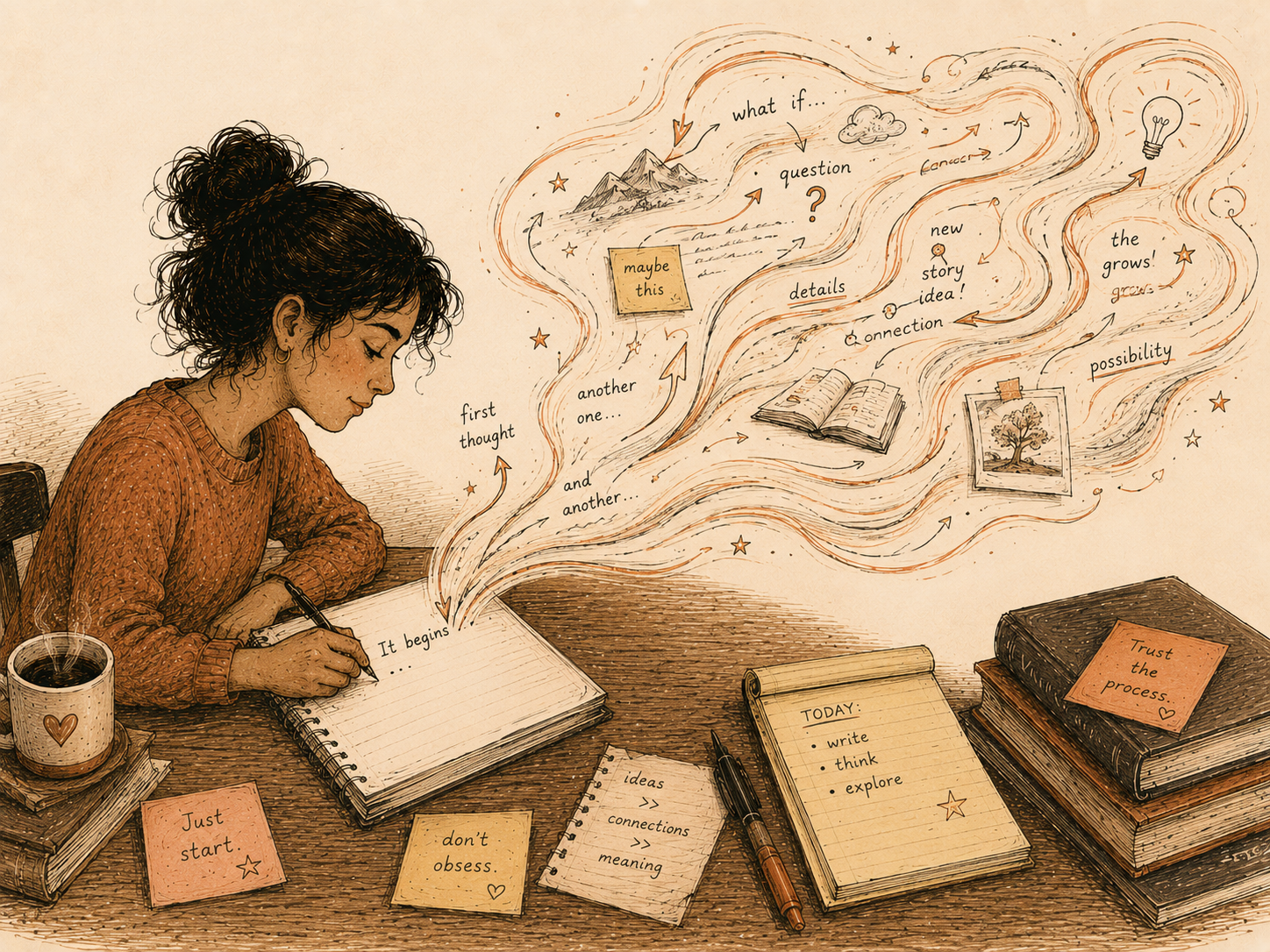
I’ll confess. This way of writing got me through undergrad and grad school (in the English department no less) at UC Berkeley. I wasn’t always particularly proud of the stuff I generated. My writing was fine - a lot of it didn’t make sense to me after I wrote it, but there were enough ideas and substance that genuinely seemed fresh, such that I generally did well in my courses.
But at some point (and I was waaaay late in figuring this out), I got tired of punishing my body and mind. It all came down to the month before I was meant to graduate and get my Ph.D. I had spent that whole month not sleeping because I was trying to finish my dissertation by the deadline in order to graduate that semester. Really. I counted 8 hours of sleep max that month. I did end up finishing. A lot of the material was stuff I liked, but could I have done it better? Yes, definitely. More to the point, could I have finished my dissertation without staying up for 30 days in a row, ruining my health and my relationships in the process? YES.
That was the turning point for me. I just didn’t want to write like that anymore. I didn’t want to ruin my life just so I could meet a deadline. For a while after that, it meant that I didn’t want to write at all. So I didn’t. After graduating with Ph.D. in hand, I worked, and even though I still had to write here and there, it was always in the context of teaching and lesson planning, so it didn’t feel as personal to me as an essay that asked me to think deeply and philosophically about a text or a film.
But at some point, I found I both needed and wanted to write again. I just wanted to do it differently. I didn’t want to torture myself. And that was my start.
Once I made that mental shift, I began with the simple mantra: Just start and don’t obsess.
To me, that meant flow-charting like nobody’s business. I gave myself the freedom to start in a way that matched the way my mind organized and flowed through ideas. I allowed myself to write on paper, write outside of the lines, use many (so many) arrows and dashes and lines and boxes, sometimes sketches, asterisks, underlines — all the things that, if done on a computer, would require special keys on your keyboard. And this was utterly liberating.
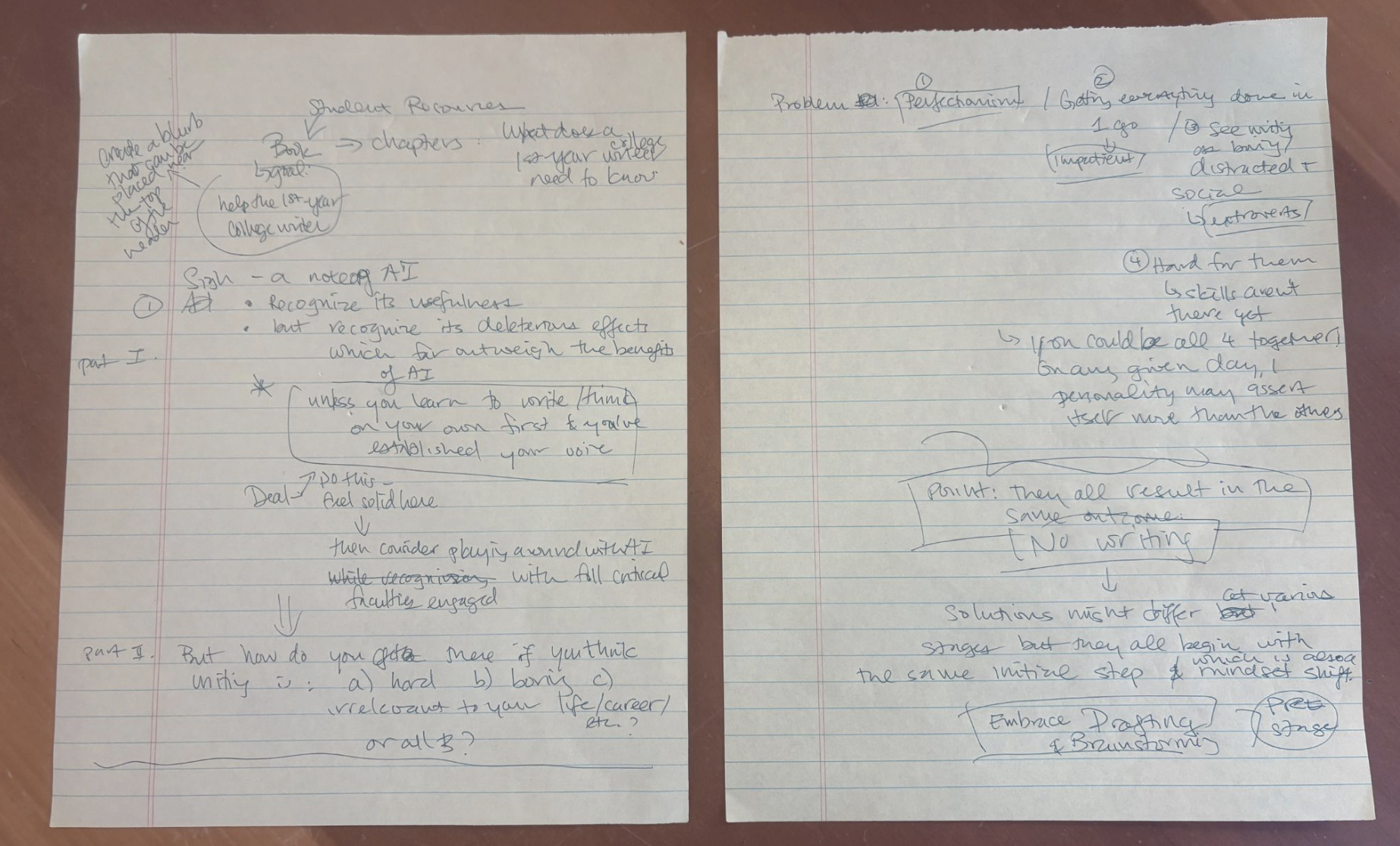
Here’s an example of what I’m talking about – a rough flowchart/outline I created before I started drafting “Chapter 1” for this site:
See what I mean by “be messy”? None of these notes would make sense to anyone, and that’s okay! These are notes, preliminary ideas, a rough sketch of what I was thinking. These notes took me somewhere between 15-20 minutes to jot down, and that was all I needed in order to feel inspired and mentally activated to start my first draft.
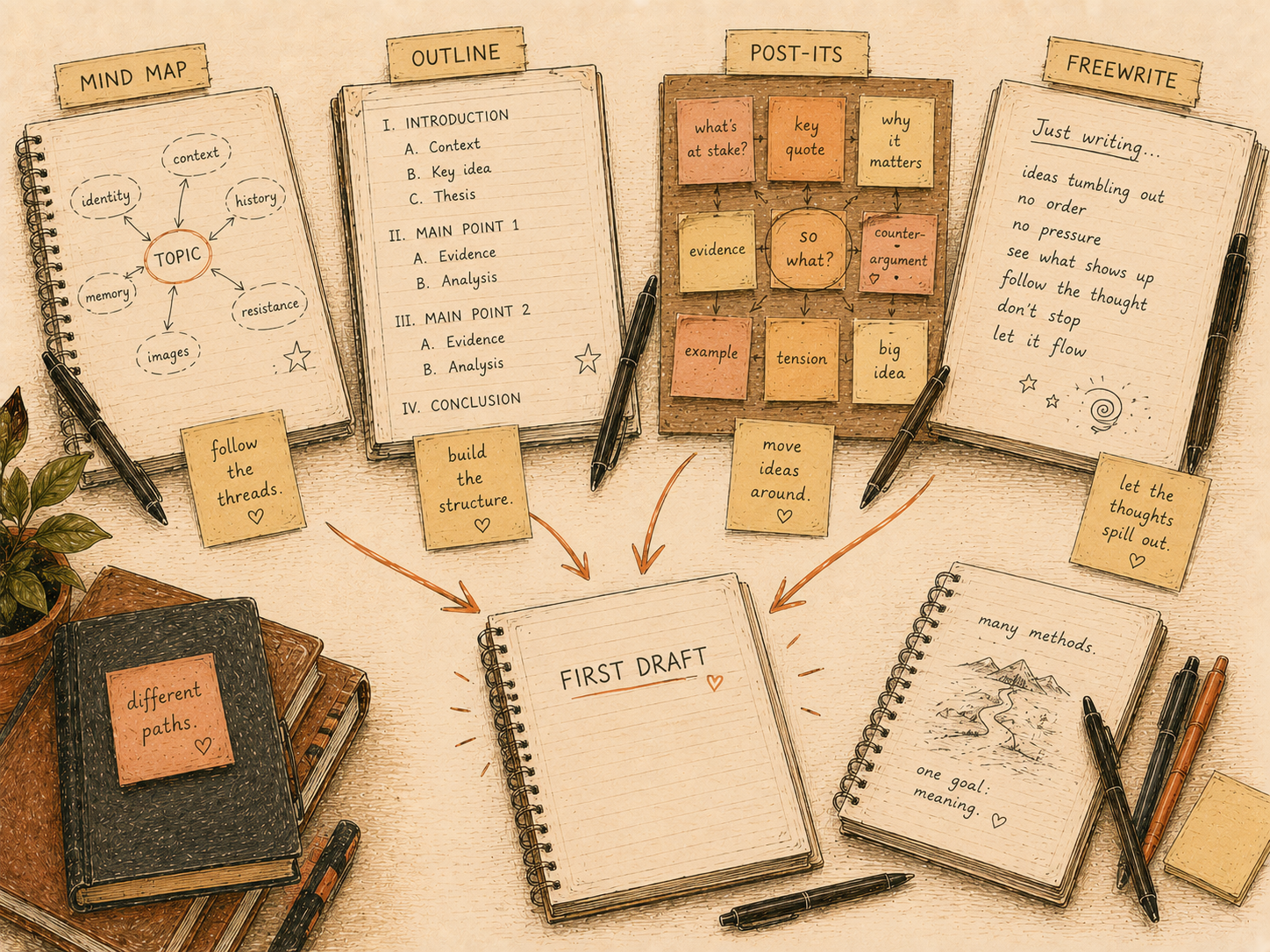
But the thing is, your mess may look different. In fact, there are many ways to just start and get messy. I like to send my beginning students to MIT’s The Writing Process, especially their page on Generating Ideas, so they understand some of the methods out there to kickstart the creative process, like brainstorming, freewriting, mind-mapping, “moodling,” and the like.
There’s nothing better, though, than just experimenting with yourself and your own process. What works for you? Free yourself up and find out. Maybe it’s a mish-mash of different methods. Or maybe you just like to use a standard outline format (like these from OWL Purdue) immediately and continually revise that outline over time.
There is no one right way. Truly. There is only your way, the way you feel works for you, that matches your creative self, that helps you get into your “flow.”
That’s the ultimate goal for this very important, first step: Get into a flow-state by committing whole-heartedly to “pre-writing.”
If you’re an athlete or a performer of any kind, you know this as warm-up. You need to warm your mind and body up, and you need to take that warm-up seriously, or else you risk an injury (or - in writing parlance - the dreaded writer’s block) further down the line.
I will also say: this is the funnest part of the writing process – at least for me! I love my messy blend of flow-charting/outlining. I love my yellow legal paper pad. I love feeling the joy of using a really smooth, gel ink pen and quickly drawing an arrow, or scratching out a line that doesn’t work, or drawing a box around an idea that really clicks for me.
What gives you that kind of sensory pleasure while you’re thinking of cool ideas? What makes your mind and fingers race with each other as ideas flow through you?
Go and find out for yourself. That’s your first – and most important – task, as a beginning writer.