

Embrace Change
Student Resources, Chapter 4
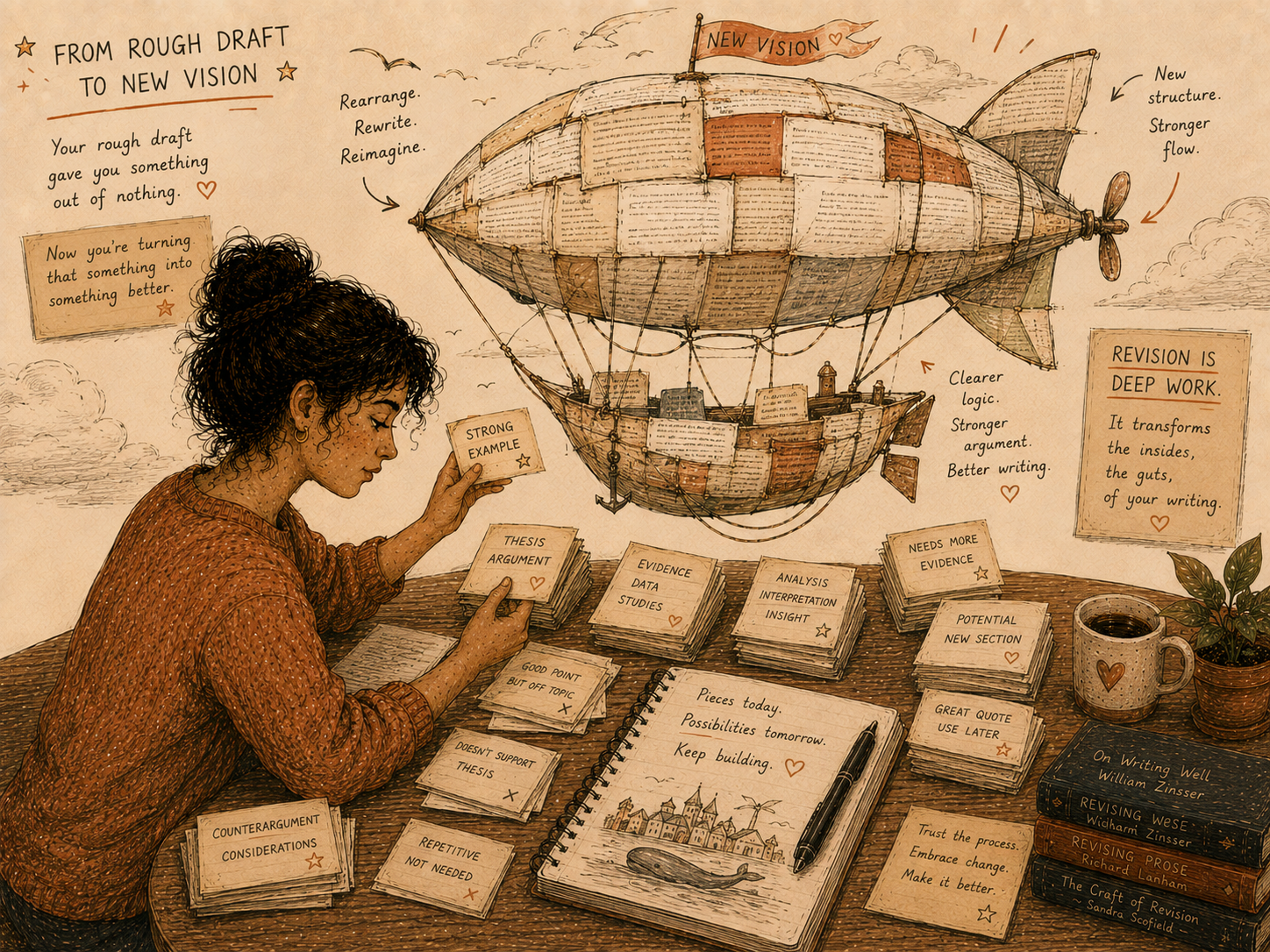
To understand revision, you first need to understand the purpose of your rough draft. That rough draft gives you (hopefully) a solid trove of ideas to work with – a glorious “brain dump.”
Once you have that in hand, revision enters the picture, and you become a doctor for your own work.
Let’s say you badly sprain one of your ankles on a Friday, and you can’t see a doctor until the following Monday. You do the best you can to take care of that ankle by following the RICE method, even if it means wrapping that ankle with an ACE bandage in the clumsiest way possible. It works just enough to get you through the weekend and into the doctor’s office on Monday. Your work on that ankle is like your rough draft.
Once you’ve hobbled your way to the doctor’s office, the doctor goes through the process of diagnosing the minutiae of that sprain, which means the doctor orders an X-ray (to rule out breaks), maybe an MRI (to figure out soft-tissue damage). The doctor probably prods and moves your foot and ankle around a little. Then the doctor figures out how to re-align and re-stabilize your ankle with the proper support – maybe an AirCast or crutches or the proper wrap, and the like. The doctor then sends you to a physical therapist who works with you to exercise and rehab that ankle so it can maintain healthy alignment and let ligaments and tendons heal properly.
That’s the work of a revision. It’s the process of re-assessing/re-diagnosing and re-structuring your work so that the force of your ideas flows cleanly through the entirety of the paper and turns into a more presentable version of its prior, hampered self.
(If you can’t tell by now, I’ve sprained my ankles a lot.)
The key to a successful revision is this: embracing change.
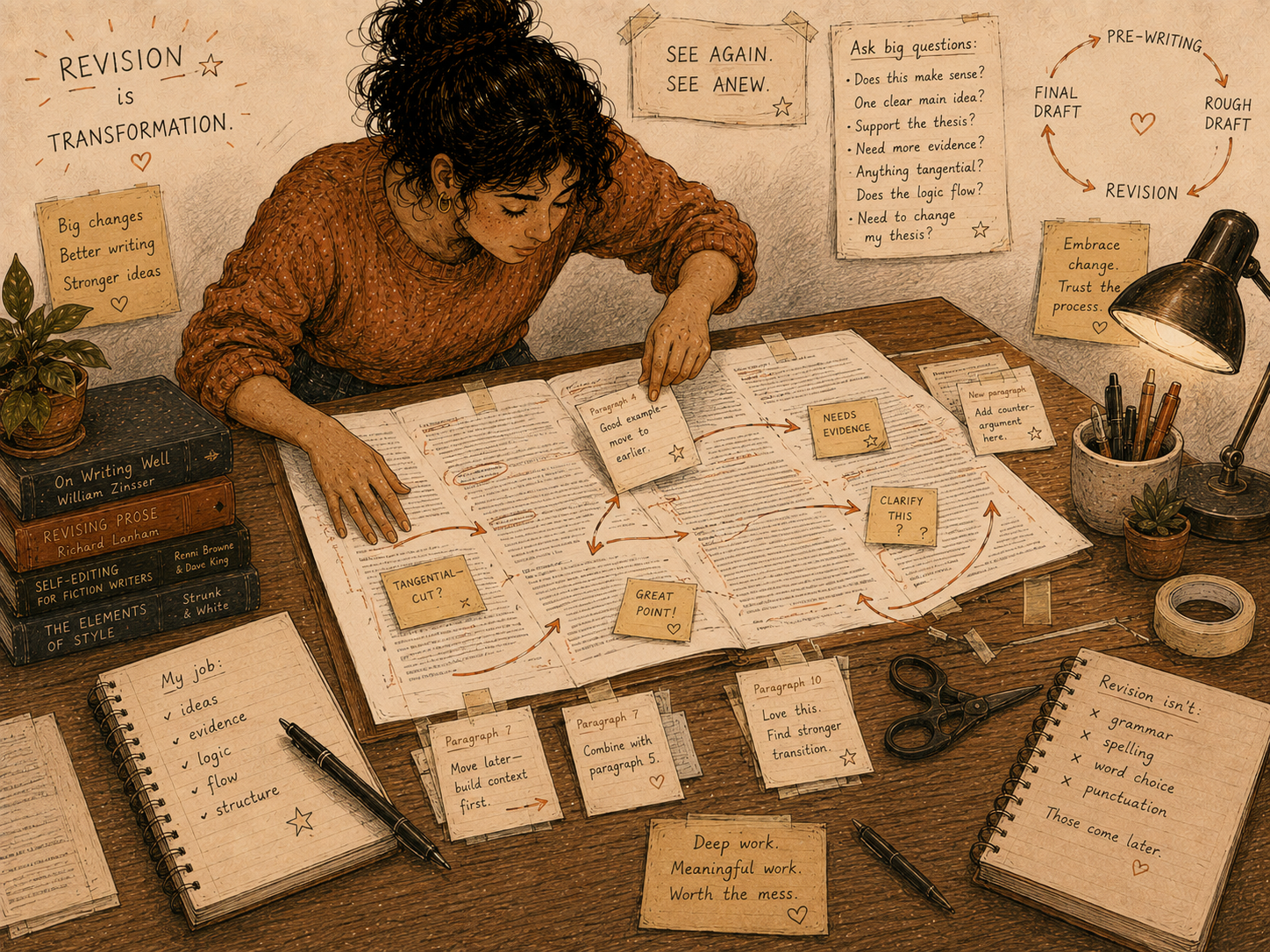
So often, beginning writers confuse this stage of writing with editing. They think that “revision” means fixing grammar or word choice or sentence structure. But it’s not – those concerns don’t really come up until the final stages of writing. Revision is the chunky middle of the writing process. Revision is about concerning yourself with the “big” things that matter the most: your ideas, your evidence, the flow of your logic.
To attend to those “big” things, you need to be willing to make big changes: delete whole paragraphs, add whole paragraphs, move paragraphs around, change your thesis argument (gasp!) – things like that. Scary things – moves that make you worry that you wasted your time writing a rough draft in the first place.
But you didn’t waste your time with that rough draft. That draft gave you something out of nothing – that’s a small miracle in itself and needs to be respected. Now you’re trying to turn that something into something better.
It’s the difference between approaching your draft like a plastic surgeon who’s giving someone a small, medically-unnecessary, face-lift and a surgeon who’s doing major, life-enabling surgery, like taking out tumors from your brain or giving you a new leg after your old leg got crushed in a massive car accident. (Don’t worry - these things haven’t happened to me; I’ve just watched too much Grey’s Anatomy over the years.)
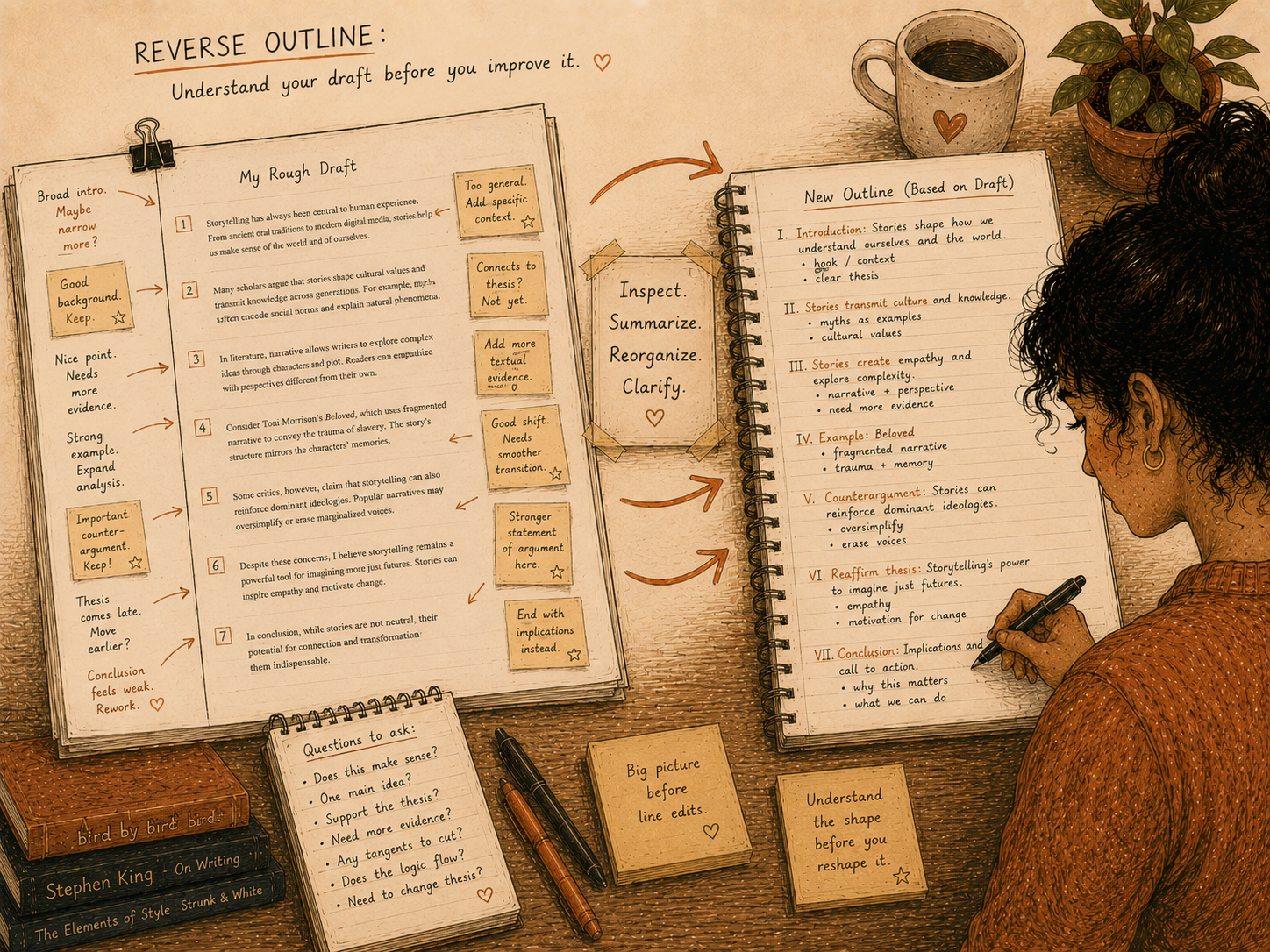
When you reverse-outline, you’re basically creating an entirely new outline based off of your completed rough draft. You inspect each paragraph of your rough draft and you ask yourself questions like these:
Does this paragraph make sense?
Does it have one, clear main idea?
Does that main idea relate to and develop the shape and logic of the overall thesis argument?
Do I need to add more evidence?
Do I include any tangential evidence or ideas that I can take out?
Does my logic flow from paragraph to paragraph or are there parts where the logic seems to stop, go circular, or seems full of gaps?
Does my thesis argument need to change to match the body of my paper?
It helps to print your essay out or work on Google docs, so you can leave marginal notes that summarize the main idea of each paragraph and your true purpose for each paragraph. These two types of information can help you understand and clarify your overall flow of logic – what you want to happen and how it’s actually happening
Once you’ve figured out how your draft works and doesn’t work by inspecting its parts, it’s much easier to move whole sections and ideas around, so you can achieve a more logical sequence of ideas.
From there, your job is to accept this new outline and rewrite. I mean it – re-write the whole draft.
Don’t go into your revision thinking you need to keep your sentences from the rough draft the same. The whole point of revision is – as so many writing teachers like to point out – to achieve a new vision, a re-vision. To see again and, in so doing, to see anew.
In other words, revision isn’t cosmetic work; it’s deep work that transforms the insides, the guts, of your writing.
To do that, you need new eyes, an open mind, as well as this process: the reverse-outline.
You need to think to yourself: your rough draft did its job. It gave you pieces to play with. Now you need to take that old configuration and reshape it into something clearer and more substantive.
I like to think of your revised draft as a mess of Lego blocks that you’re now using to create an airship or a village or a whale.
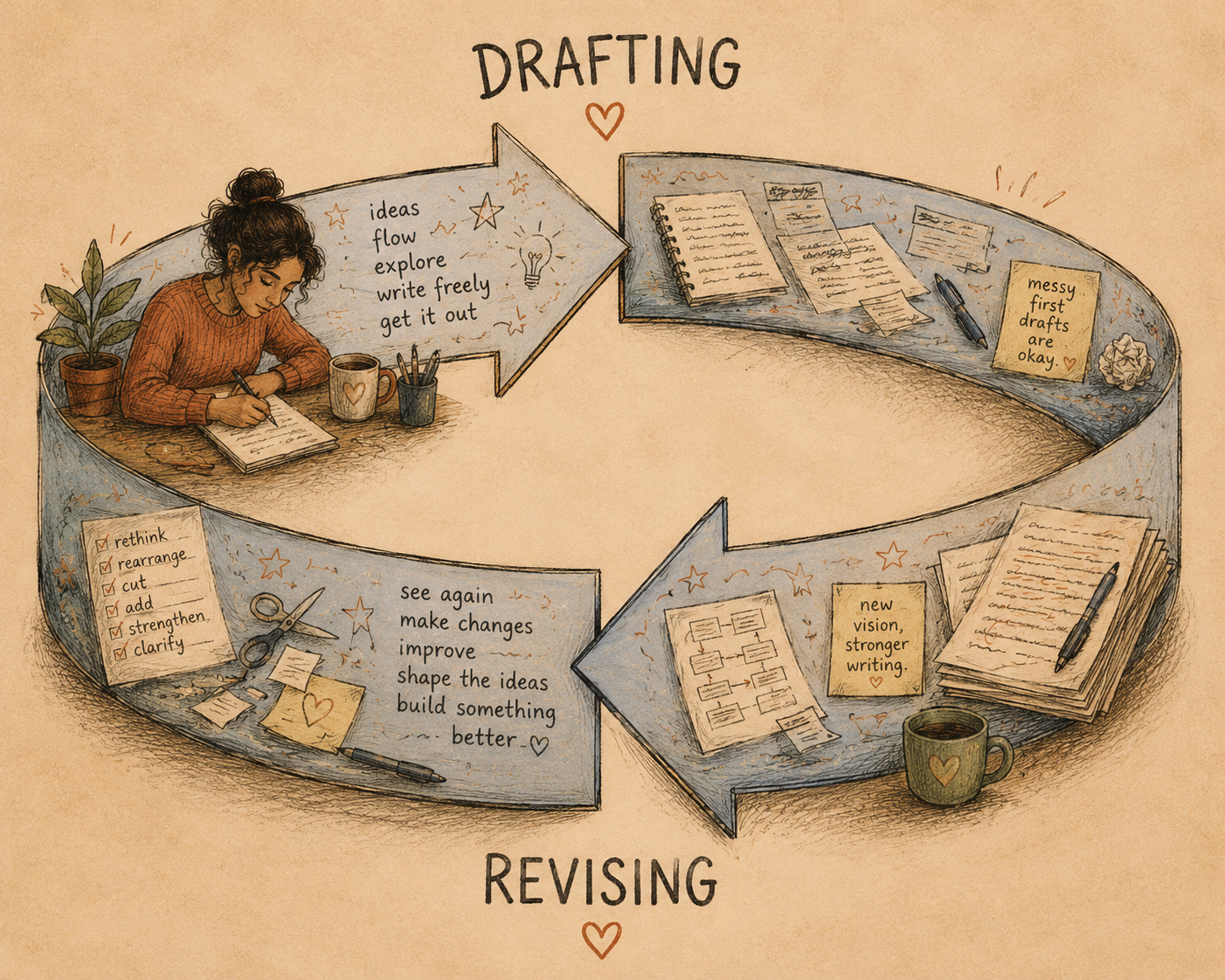
Let me add this clarifying note too: while it can help to think of the writing process as a linear sequence of stages (pre-writing → rough draft → revision → edits → final product), reality is often much more circular. By this point in the writing process, you might find that it’s actually productive to bounce back and forth between drafting and revising. You might even find yourself generating more “pre-writing.” The human mind doesn’t often move forward in a straight line; it can move laterally, diagonally, circularly. So why should you expect your writing process to proceed in one clean, singular direction?
So you can actually be more productive if you allow yourself some grace and approach this middle part of your writing process, even the entire process as a whole, more like a virtuous circle:
Don’t worry. Eventually, you’ll get to the point where you’ll feel settled enough, with a revised draft that’s good enough, so you can move on to polishing your writing into an edited, publishable, “final” version. An external deadline will also move you to this point eventually.
But you need to let this middle part – revising, rewriting (and maybe re-drafting) – breathe fully, like a deep belly breath. Give yourself the freedom to make radical changes.