

Stay Messy
Student Resources, Chapter 3

All right. You just finished your “pre-writing,” and you’re feeling primed! That messy, fun stage of scribbling whatever you wanted to scribble, however you wanted to scribble it, has done its job. You’re now ready to draft.
So how do you continue that energy? That rushing, inspired feeling, that flow? What should your mantra be now?
I say this: “Stay messy.”
How do you do that? Before moving on, I highly suggest you just go and read Anne LaMott’s widely taught essay “Shitty First Drafts.” She’s awesome. And so fun to read. She will make you understand that first drafts (and, sometimes, for me, even second and third drafts) should be “shitty.”
I love that word. It gets her point across, doesn’t it? You can’t be a perfectionist about writing – not at this stage. (And, arguably, not at any stage because what is perfection anyway?! Does it even exist?! Short answer: No – it really doesn’t.).
What does it mean to view your first drafts from this perspective?
For some people (and, sometimes, I’m in this group), that means you continue drafting your writing out, by hand, on paper. That tactile feeling of pen on paper can activate your mind and creative flow in ways that computer typing might not. Don’t believe me? You don’t have to – you can go and believe experts who’ve generated studies about this (here’s a 2025 study on the benefits of writing by hand, or you can glance at this 2024 Psychology Today article for a more popular rundown on the topic).
But if you’re at the point where you feel you can just start typing, then, by all means, go to your computer. Just remember – that “delete” key is a little evil. You need to control your use of it because you can “delete” yourself to death and, then, all of a sudden, your flow has stopped flowing.
If you can’t stop deleting your writing and you’re getting to the point that writing is feeling like stop-start traffic on a backed-up highway, then you can do a few things. You can stop using the “delete” key. You can also just stop writing and walk away. You can turn to pen and paper.
So, here’s where we get to some methods for dealing with or pre-empting writer’s block. The thing to note is that these methods basically deal with the concept of time-management (or the assumption that creative workflow doesn’t or can’t last forever) and setting (or the assumption that place matters). Here are some methods broken down into those two categories of time and setting:
Can you adapt your strategies and methods to the way your life goes up and down? Can you prioritize your writing and thinking so that they can fit into those ups and downs?
That requires both self-discipline and openness. That may mean something like going to a rave or to a party, but making sure that you churned out your rough draft before you go to that rave or party. (I emphasize that “before” because who knows what your mind and body will be like after a night out?)
Prioritizing your drafting period will be a lot easier to do though if you - again - recall that super-important mantra I gave you up at the top: Stay messy!
Time:
Block out 1 or 2 hours to churn out a whole rough draft. Be disciplined about sticking to that time block. Do not “correct” your writing.
Activate the Pomodoro Technique and write in ~20-25 minute chunks; then, take a break and do something else entirely. Also, do not “correct” your writing.
Setting:
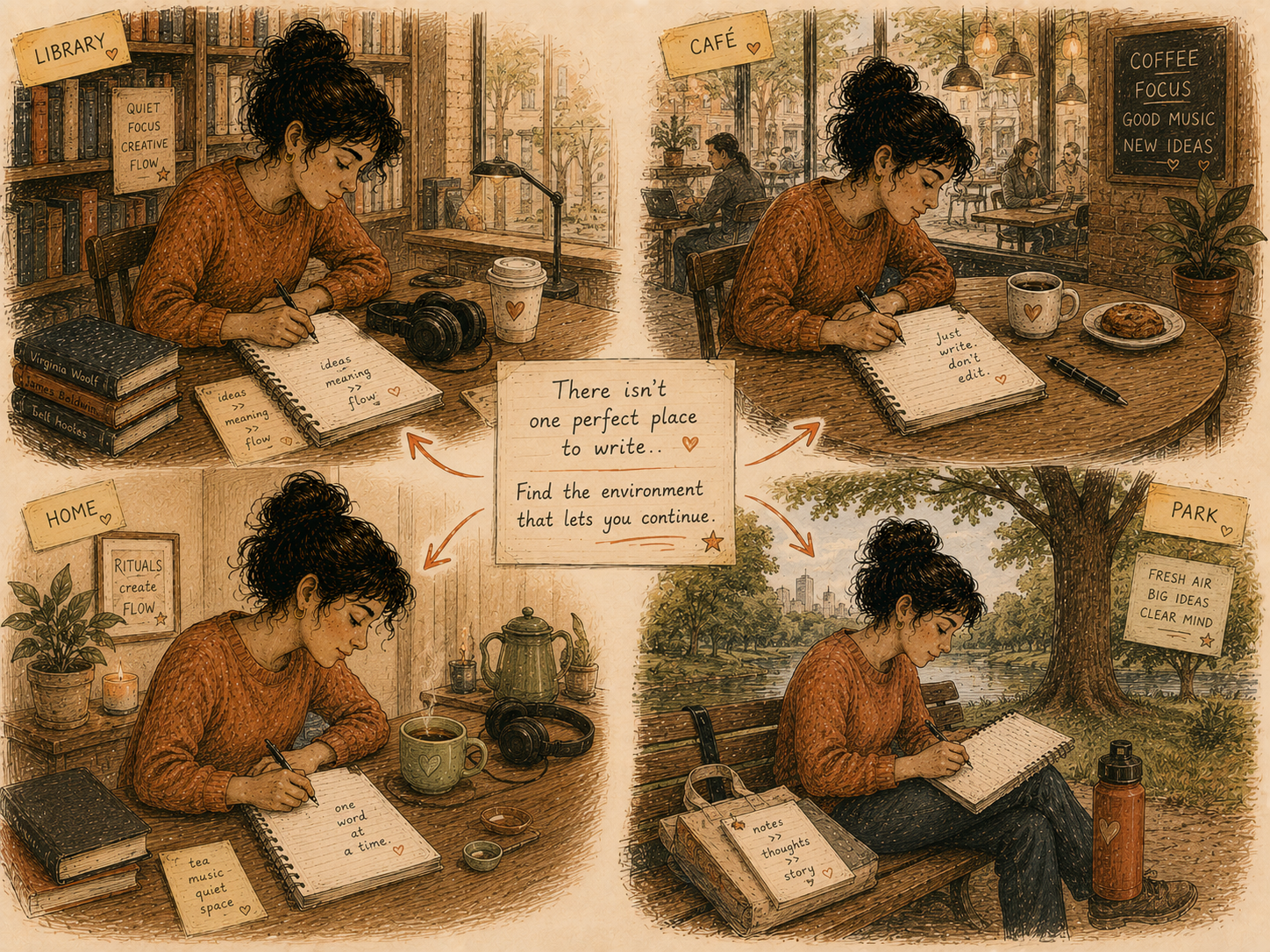
Sit at a public place that allows for individual work, like a library or a cafe. If you’re lucky, your instructor might give you drafting time in class, which can similarly benefit you, the way a library or cafe would.
Use headphones either to play music you like or block out sound you don’t like.
Find a quiet space with no distractions.
You might blend these methods or find some other creative way to deal with time and setting. The important thing to note is that you need to prioritize these two concepts and embrace them as crucial partners to your writing process.
Another way to approach drafting is to create a ritual around the process. This can begin as early as your pre-writing stage; it can also begin here, at this stage, as you start drafting a whole essay. In fact, it can begin and repeat at any point along the journey to creating your writing.
Maybe you light some incense in your room. Maybe you meditate for 20 minutes over a cup of tea. Maybe you go buy a cup of coffee, walk home, then sit at a desk. Maybe you go to the gym for an hour. Maybe you dance around your room for the length of a song. Maybe you prepare a bag of potato chips next to your computer because snacks are amazing and yummy and fun to eat.
The point: Experiment with what feels good, what motivates you, and what keeps you motivated as you start and continue to draft.
And then be flexible with yourself. I can be a different person, on different days. I don’t think it’s a bad assumption to say that most people are probably like this. You have needs and wants, and those can change depending on your day-to-day schedule and your feelings and whatever life throws at you. So your “ritual” might change. Your methods might change.
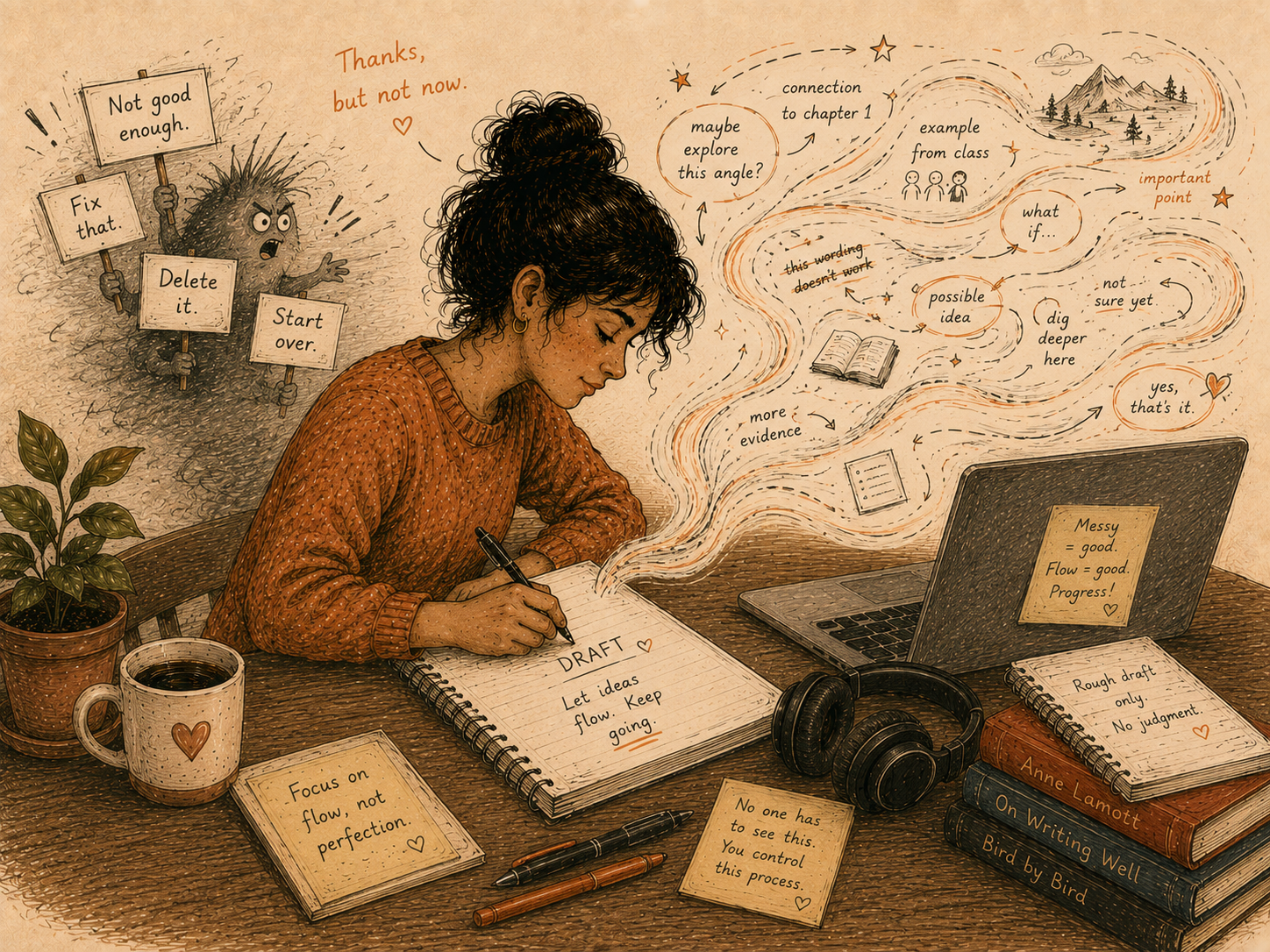
If you approach your first/rough draft without that mantra in mind, drafting won’t be drafting anymore. It’s going to feel like the worst kind of work – the kind that makes you stress out. And once you start stressing over a rough draft, you’ll start engaging in behaviors that stop writing from progressing entirely: procrastinating, obsessing over things like grammar/word choice/syntax (the wrong things to care about at this stage), using AI to do the creative work for you… You catch my drift, right?
So you need to undergo a massive mindshift first. Mess = good = flow = fun = productive. Remember: No one has to ever see this rough draft! Not if you don’t want them to! No one is there to judge you! So don’t judge yourself!
Of course, your instructor might ask you to share your draft for peer review. That’s actually important to do and really helpful in the broad scheme of things, but that’s for another article.
The point is this: You control the way you approach drafting and how much you criticize your own writing. So it’s on you to tell your inner critic to shut up. As long as you’re drafting, your inner critic needs to disappear. Not forever, but for a good long while. It’s hard to get any kind of work out if you become your own naysayer.
If you approach your rough draft this way, and then stay attuned to what keeps that feeling of messy productivity alive for you, you’re going to finish that rough draft in far less time than you imagined, AND it’s going to feel a lot easier than trying to write a “perfect paper” in one go.
More to the point, you’re going to be ready for the next stage in the process: Revision – or that moment when your writing starts to turn into something that feels “real.”